|
มูลนิธิอภิธรรมมูลนิธิ |
|||||||||

| Moonlanithi |
Vipassana Meditation |
OnlineStudy thai english |
Article |
สำนักวิปัสสนา อ้อมน้อย |
กิจกรรม | About Us |
|
มูลนิธิอภิธรรมมูลนิธิ |
|||||||||
| Moonlanithi |
Vipassana Meditation |
OnlineStudy thai english |
Article |
สำนักวิปัสสนา อ้อมน้อย |
กิจกรรม | About Us |
Birth of the Buddha
Conflicting sectarian accounts of the miraculous day make it hard to separate fact from fiction
Most Buddhists across the world are familiar with the myth of the miraculous birth of the Buddha: He is said to be the only son of Queen Maya and King Suddodhana of Kapilavatthu. Many modern Buddhists do not believe the myths surrounding the birth, while some fundamentalists take the story literally.
The story goes that Queen Maya delivered her baby while walking in Lumpini Park, which is situated between the Indian cities of Devadhaha and Kapilavatthu. While she was experiencing delivery pains, a branch of the Sala tree bent down to receive her hand. With her right hand holding the proffered tree branch, she gave birth to her baby in a standing position. The baby bodhisattva descended from her womb, handed down by Brahma gods before passing to the hands of Queen Maya’s maids.
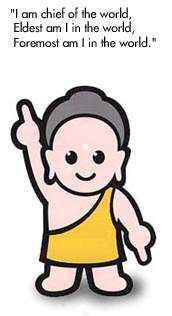
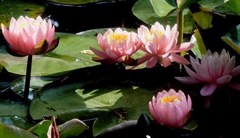
Then this miracle occurred: The baby strolled seven steps on the ground and, at each step, a lotus flower bloomed up to receive his feet. Finally, on the seventh lotus (in some versions), the baby was seen as a youth and said: “I am the best in the world. This will be my last birth.”
The miraculous birth of the Buddha has puzzled Buddhists for many hundreds of years. While some Buddhists are content to believe the myth and have no desire to look for a further interpretation, others feel that the account needs further interpretation.โดย พี่เณร..นำมาฝาก [23 มิ.ย. 2547 , 17:16:33 น.] ( IP = 202.176.91.217 : : ) [ 1 ] [ 2 ]
สลักธรรม 1The majority of Buddhists in Theravada countries believe that the Buddha was born, enlightened and died on the same day of the year – the full moon day of the Vesaka month, which is in May or June of our current calendar. Buddhists of the Mahayana tradition do not share this belief, however, and do not celebrate the same holy day of the Buddha.
The Tipitaka is silent about the time of the Buddha’s birth and awakening. Only one sutra describes the Buddha as passing on after his last rainy season retreat (approximately November to February). Actually, the legend that the Buddha was born, enlightened and passed away on the same day originated in Sri Lanka sometime after Buddhism was an established religion in the country. While the myth has no canonical reference to support it, the celebration was later propagated in other Theravada countries in Southeast Asia where it has been carried down to the present time.
Modern Buddhists cannot accept the Buddha’s miraculous birth as described in scripture. One wonders if there is a reasonable explanation for the origin of the story.
Was it hearsay, a confused version passed down by word-of-mouth, or simply a well-plotted yarn to inspire the faith of Buddhists? Several thinkers have evolved different opinions about the miracle.
Consider the two images in the miracle of the Buddha’s birth. First, the lotus flowers. And second, the seven steps related to the development of the bodhisattva. Lotus flowers are the symbol of enlightenment in Buddhist mythology and are compared to enlightened persons, or, on some occasions, the body of Buddhist teaching.
โดย พี่เณร..นำมาฝาก [23 มิ.ย. 2547 , 17:18:35 น.] ( IP = 202.176.91.217 : : )
สลักธรรม 2The number seven is difficult to interpret since it can refer to many groups of doctrines in the Tipitaka. For example, there are seven factors conducive to awakening (the so-called seven bojjhangas). And the Buddha visited seven states of ancient India during his mission. However neither of these “sevens” are necessarily related to the proclamations of the baby bodhisattva.
Yet another possible interpretation is that the seven steps have nothing to do with the doctrine of the Buddha at all. Historically, the Buddha was not the foremost religious leader of his time.
At the time the Buddha became enlightened, there were already six other spiritual leaders; their names are frequently referred to in aphorisms and the “Book of Monastic Discipline”. So he was the seventh guru, as reported in the Tipitaka. Perhaps this is the most appropriate interpretation for the seven steps. Putting the images in the birth miracle of the Buddha together, we can see the relationship between the bodhisattva and other gurus who were his contemporaries. The myth conveys a clear message to the Indian people about who the Buddha was when compared to the people of the world and the six other gurus: the Buddha was the most excellent man on Earth and had transcended the teachings of the six other spiritual leaders of his time.
โดย พี่เณร..นำมาฝาก [23 มิ.ย. 2547 , 17:20:29 น.] ( IP = 202.176.91.217 : : )
สลักธรรม 3Most likely, the myth emerged in the Buddhist community soon after the Buddha had passed away. It served as propaganda for the teaching of the Buddha in relation to the other six schools of ascetics in India that existed 2,500 years ago. Only one of them survived to modern times – Jainism.
What really happened during the birth of the baby bodhisattva? It’s simple: He was born normally like other babies of his time. In conclusion, there are no compelling reasons to take the myth literally.
Mettanando Bhikkhu
Venerable Mettanando Bhikkhu is a Thai Buddhist monk and a former physician. He studied at Chulalongkorn University, Oxford, Harvard and received a PhD from Hamburg. He is also special adviser on Buddhist affairs to the secretary-general of the World Conference of Religions for Peace.
The Nation
Published on Jun 2, 2004
โดย พี่เณร..นำมาฝาก [23 มิ.ย. 2547 , 17:21:20 น.] ( IP = 202.176.91.217 : : )
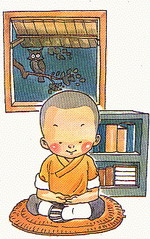
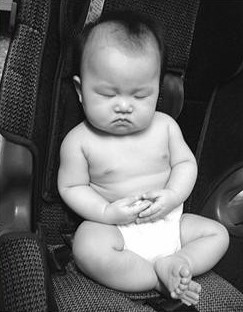
สลักธรรม 4MEDITATION classes for children are gaining popularity in Tasmania as young people look for tools to combat stress.Children aged between eight and 12 studied basic meditation techniques during a one-day course at Dromedary yesterday. Course teacher Jacquie Stephens said young people were keen to learn ways of managing internal conflict.
"Just like adults, children have tensions, anxiety and stresses," Mrs Stephens said. "This is a way they can calm their mind down -- a tool they can use in daily life." Mrs Stephens, who runs the course at the Vipassana Meditation Centre, said children could acquire techniques to help them for life.
"The younger people learn about meditation the better," she said. "I wish I had learnt this when I was a kid because it would have saved me a lot of stress in my teenage years." She said children's minds were open to the concepts of meditation and often grasped techniques better than adults. "They find it easier because they don't have as much intellectual garbage as we adults do," she said. "They take to it like ducks to water."
โดย พี่เณร..นำมาฝาก [23 มิ.ย. 2547 , 17:23:02 น.] ( IP = 202.176.91.217 : : )
สลักธรรม 5Yesterday's introductory course focused on simple breathing techniques, called Anapana meditation. The technique is aimed at improving concentration and memory, increasing alertness, building self confidence and increasing goodwill towards others. The centre is looking at following up the children's courses with programs designed for teenagers.
ต้องขออนุโมทนาสาธุกับกุศลเจตนาของท่านทุกๆท่านที่เพียรพยายามเผยแผ่ความรู้แห่งพระพุทธศาสนาให้ทั่วโลกได้รู้จักนะครับ สาธุ สาธุ สาธุโดย พี่เณร..นำมาฝาก [23 มิ.ย. 2547 , 17:31:45 น.] ( IP = 210.86.188.12 : : )
สลักธรรม 6ขอบคุณค่ะพี่เณร มีความรู้สึกที่ดีนะคะที่ชาวต่างชาติได้หันมาศึกษาในพระพุทธศาสนา พุทธประวัติ และยังอธิบายความหมายความสำคัญของ lotus and seven steps
และเมือนำหลักแห่สมาธิไปใช้กับเด็ก ได้รับผลต่อชีวิตประจำวันได้เป็นอย่างดี และได้รับความรู้สึกเหมือนเป็นเริงร่าได้เล่นน้ำโดย น้องอุ๊ [23 มิ.ย. 2547 , 21:44:25 น.] ( IP = 203.107.210.120 : : )
สลักธรรม 7
โห้ยยยย... ภาษาอังกฤษ..เห็นแล้วก็ตาลาย กว่าจะอ่านรู้เรื่องโห้ยยยย...
ขอบพระคุณค่ะพี่เณร...(การ์ตูนน่ารัก..)โดย น้องกิ๊ฟ [23 มิ.ย. 2547 , 23:39:36 น.] ( IP = 202.129.44.34 : : )
สลักธรรม 8
สมาธิมีผลต่อการเรียนรู้ของเด็ก ๆ อยู่ไม่น้อย เคยได้ยินหลักสูตรสมาธิสำหรับเด็กมาบ้าง ไม่แน่ใจว่าสถานที่ดังกล่าว มีการสอนเกี่ยวกับวิปัสสนาแบบเด็ก ๆ ด้วยหรือไม่
อยากรู้จัง เห็นตั้งชื่อ The Vipassana Meditation Centreโดย น้องถ้วย [23 มิ.ย. 2547 , 23:46:11 น.] ( IP = 203.149.37.220 : : )
สลักธรรม 9vipassana
To attain the ultimate benefit, vipassana needs to be practiced intensively. So it requires conditions that supports full-time practiced in a retreat environment. Such retreat centres are dedicated to the practice, usually to the exclusion of any religious or study activities.
This is a modern trend in Buddhism originating in Burma after the Second World War when the Burmese Prime Minister U Nu, a very keen meditator, invited the late Venerable Mahasi Sayadaw to teach in a meditation centre he set up in Rangoon, the Mahasi Sasana Yeiktha. This was the beginning of the modern revival of vipassana meditation led by Mahasi Sayadaw and his contemporary Sayagi U Ba Kin.
In today's Buddhism, a worldwide meditation culture has evolved which caters for lay meditators who are not necessarily Buddhists, often with lay teachers, supported by senior monastic teachers in the lineage. It has prove to be popular as vipassana techniques can be systematically taught and there is a pool of knowledge and experience with a variety of trained teachers.
โดย น้องแก้วค่ะ [24 มิ.ย. 2547 , 16:44:55 น.] ( IP = 202.176.91.241 : : )
สลักธรรม 10The retreats can run for two, four, nine, sixteen or thirty days. They are conducted in silence, which includes no talking, no communication through body language, no listening to music, no reading or no writing except for brief notes recording the meditation experience. However, there are opportunities to discuss the practice with the teacher through individual consultations or group discussion.
A typical retreat day begins at 5 am and ends at 10 pm, with a rest period in the middle of the day. The whole day is spent practicing sitting and walking meditation, cultivating continuous attention to the changing nature of the moment-to-moment experience. The retreat teacher gives evening talks to inspire and explain the practice as well as conduct interviews.
A meditation retreat is a serious undertaking, which requires effort and self-discipline. A retreat is not a chance to escape the pressures of daily life, nor a time out in which to do your own thing. Rather is is an opportunity to cultivate the Buddha's way of liberation through the practice of ethics, meditation, and understanding. Walking this path, we can learn to abandon actions of body, speech and mind that bring suffering to ourselves and those around us, and cultivate actions that bring happiness and harmony to ourselves and those around us.
…โดย น้องแก้วค่ะ [24 มิ.ย. 2547 , 16:46:01 น.] ( IP = 202.176.91.241 : : ) [ 1 ] [ 2 ]
ขอเชิญแสดงความคิดเห็น คำเตือน
- การแอบอ้างใช้ชื่อบุคคลซึ่งอาจทำให้บุคคลนั้นเกิดความเสียหาย อาจถูกดำเนินคดีทางกฏหมายได้
- การโพสรูปภาพที่ไม่เหมาะสม หรือ ไม่ได้รับอนุญาตจากเจ้าของภาพ อาจถูกดำเนินคดีทางกฏหมายได้
- หากพบเห็นรูปภาพหรือกระทู้ที่ไม่เหมาะสมสามารถเมล์เข้ามาได้ที่ freewebboard@thaimisc.com โดยระบุ subject "กระทู้ไม่เหมาะสม" พร้อมทั้งระบุ ADDRESS ของเว็บบอร์ด
ผู้ช่วยเหลือ-แหล่งข้อมูล |
[ คีตธรรม ] [ ตารางสี ] [ ค้นหาเพลง ] |
ลานภาพ |
ค้นหา |
สร้างสรรค์โดย |