|
มูลนิธิอภิธรรมมูลนิธิ |
|||||||||

| Moonlanithi |
Vipassana Meditation |
OnlineStudy thai english |
Article |
สำนักวิปัสสนา อ้อมน้อย |
กิจกรรม | About Us |
|
มูลนิธิอภิธรรมมูลนิธิ |
|||||||||
| Moonlanithi |
Vipassana Meditation |
OnlineStudy thai english |
Article |
สำนักวิปัสสนา อ้อมน้อย |
กิจกรรม | About Us |
Birth of the Buddha
Conflicting sectarian accounts of the miraculous day make it hard to separate fact from fiction
Most Buddhists across the world are familiar with the myth of the miraculous birth of the Buddha: He is said to be the only son of Queen Maya and King Suddodhana of Kapilavatthu. Many modern Buddhists do not believe the myths surrounding the birth, while some fundamentalists take the story literally.
The story goes that Queen Maya delivered her baby while walking in Lumpini Park, which is situated between the Indian cities of Devadhaha and Kapilavatthu. While she was experiencing delivery pains, a branch of the Sala tree bent down to receive her hand. With her right hand holding the proffered tree branch, she gave birth to her baby in a standing position. The baby bodhisattva descended from her womb, handed down by Brahma gods before passing to the hands of Queen Maya’s maids.
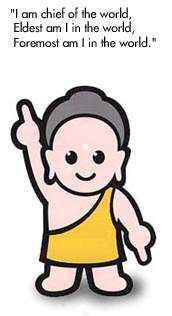
Then this miracle occurred: The baby strolled seven steps on the ground and, at each step, a lotus flower bloomed up to receive his feet. Finally, on the seventh lotus (in some versions), the baby was seen as a youth and said: “I am the best in the world. This will be my last birth.”
The miraculous birth of the Buddha has puzzled Buddhists for many hundreds of years. While some Buddhists are content to believe the myth and have no desire to look for a further interpretation, others feel that the account needs further interpretation.โดย พี่เณร..นำมาฝาก [23 มิ.ย. 2547 , 17:16:33 น.] ( IP = 202.176.91.217 : : ) [ 1 ] [ 2 ]
สลักธรรม 111. Sitting - the primary focus is on the rise and fall movement of the abdomen, switching to secondary objects, such as pain, sensations, thinking, etc as they arise.
2. Walking - the component parts of the steps in walking are noted and known in fine detail.
3. Daily Activities - detailed awareness of all body movements and actions with the support of mental noting or labeling throughout the day's activities.
Linking these three areas of practice together will create an unbroken 'thread of awareness' that will give momentum to the practice.…
The Technique of Mental Noting
A useful device to support meditative attention is naming or labeling the various objects during the investigation of your own body and mind. Used judiciously, it is a useful tool for focusing and sustaining the attention. The noting is done by repeatedly making a mental note of whatever arises in your body and mind experience. For example, 'hearing', 'hearing', 'thinking', 'thinking', 'touching', 'touching', etc. This is a powerful aid to help establish attentiveness, especially at the beginning of the practice, when it is vital to systematically note or label as much as possible to establish the attention. Otherwise, you are likely to get lost in unnoticed wanderings with long periods of inattention.…โดย น้องแก้วค่ะ [24 มิ.ย. 2547 , 16:47:50 น.] ( IP = 202.176.91.241 : : )
สลักธรรม 12It is only when you have succeeded in sustaining the attention can the mental noting be dropped. If the noting has become mechanical or is so clumsy that it is interfering with the subtle attention then one needs to do it more lightly. In noting, ninety percent or more of the effort should go into being with the experience of the object, the rest in the labeling.
Having acquired the ability to monitor your experience with just bare attention, you will need to return to the mental noting only when the attention weakens, is lost or needs to be re?established. The mental noting can be combined with the practice of orientating to your sense impressions by the naming of the physical and mental objects as they arise at the six sense doors. Be careful not to analyze what is being observed, just register or note it without reaction.
…โดย น้องแก้วค่ะ [24 มิ.ย. 2547 , 16:48:37 น.] ( IP = 202.176.91.241 : : )
สลักธรรม 13Instruction for Sitting Meditation
The first step is to find a balanced sitting posture. You should be relaxed yet your spine should be straight - you may have noticed how a 5-year-old sits up in a balanced way without effort. Allow your head to balance freely on the spine, checking that it is not pulled back or fixed. Allow your chin to drop so that your eyes and ears are at about the same level.
If sitting on the floor, use cushion(s) so that your knees are below your hips and in contact with the floor (otherwise your spine will collapse) or else use a chair with a firm base (not a sofa). Slumping only increases the pressure on the legs and discomfort in the back. Try radiating loving-kindness above and below and in all directions around you to check that you are not holding or contracting in the front or the back, etc. Check that your breathing is free and easy - any restriction indicates a fixed posture. Turn your awareness to the parts of your body, which contact the cushion, ground or chair, softening onto the supporting surfaces.
It is useful to spend five minutes scanning the body in this way. Note that there is no such thing as 'perfect posture' and postural aches will come and go as a natural part of the unfolding practice. If pain becomes overwhelming or is due to injury, mindfully adjust the posture after noting the various sensations. However, as concentration develops, sensations of hotness, stiffness and itchiness will arise as part of the contemplation of feeling and sensation, and it is important to note them mindfully without fidgeting.
It is important to attend to your posture with wisdom, not insensitive willpower. Posture will improve with time, but you need to work with the body, not use force against it. If you have a lot of pain during a period of sitting, change posture, sit on a small stool or chair, or stand up for a while.
…โดย น้องแก้วค่ะ [24 มิ.ย. 2547 , 16:49:57 น.] ( IP = 202.176.91.241 : : )
สลักธรรม 14…Checking your posture
· Are the hips leaning back? This will cause a slump.
· The small of the back should retain its natural, unforced curve so that the abdomen is forward and 'open'.
· Imagine that someone is gently pushing between the shoulder blades, but keep the muscles relaxed.
· Note, and gently release, any tension in the neck/shoulder region.
Once you have settled into a comfortable, upright, balanced position you can begin meditating.
On the basis of working from the gross to the subtle, i.e. from the body to the mind, feel the touch sensations of hardness or softness from the body's contact with the ground or chair (earth element). This will help to anchor the attention to the body, especially when assisted by the mental label of 'touching', 'touching'. Then tune into the natural rising and falling movement of the lower abdomen, making a mental note or label of 'rising', 'rising' concurrent with the upward movement and 'falling', 'falling' with the downward movement.
Make sure when noting the rise and fall movement of the abdomen that you are connecting with the airflow and are not merely knowing the conceptual form and shape of the abdomen. You are always looking for the specific characteristics - the subtlest phenomena, the fine nuances of the movement.
It is important to be alert to the specific characteristics of the various elements under observation, e.g., the series of sensations from the movement of the abdomen (wind element) or the specific characteristics found in pain such as heat, throbbing, etc (fire element). The traditional sitting posture gives the right environmental conditions and allows you to focus intensely and apprehend, at a microscopic level, the body's elements and the subtle mind events.โดย น้องแก้วค่ะ [24 มิ.ย. 2547 , 16:51:32 น.] ( IP = 202.176.91.241 : : )
สลักธรรม 15The Transition in the Change Over
At the end of each sitting session make a gentle transition. That is do not abruptly drop the meditation, but carefully follow through to being aware of unfolding the limbs, noting the release of the pressure in the posture, the movements in standing up and stretching, thereby carrying the practise into the next activity. Take extra care in the traveling between the sitting posture and the formal walking meditation. Try to do it without a break - as it is the continuity of the practice that will deepen it.
…โดย น้องแก้วค่ะ [24 มิ.ย. 2547 , 16:52:32 น.] ( IP = 202.176.91.241 : : )
สลักธรรม 16ขอบพระคุณค่ะ สำหรับแนวทางการเจริญสติอย่างละเอียด ด้วยภาษาธรรมที่แตกต่าง
พี่ดอกแก้วเปี๊ยนไป่ หนูชอบชอบค่ะ
โดย น้องถ้วย [25 มิ.ย. 2547 , 16:13:06 น.] ( IP = 202.28.180.6 : : unknown )
สลักธรรม 17
น้องถ้วยมาเมฆ
แหมพี่เณรผ่านมาผ่านไปหลายรอบแล้ว
อยากแวะแต่ไม่แวะดีกว่า
กลัวเปลี๋ยนไป๋ 5555…โดย พี่เณร [25 มิ.ย. 2547 , 21:42:37 น.] ( IP = 210.86.188.0 : : )
สลักธรรม 18โห !!! พี่เณรเล่นเอาเจ้าตูบมายักคิ้วเชิญชวนอย่างนี้ น้องถ้วยก็ขำกลิ้ง สติแตกหมดเลยอ่ะฮะ อุตส่าห์ประคองมาดีดี อิ อิ
โดย น้องถ้วยค่ะ [29 มิ.ย. 2547 , 16:12:36 น.] ( IP = 202.28.180.6 : : unknown )
สลักธรรม 19เข้ามาอ่านพระพุทธประวัติภาคอังกฤษ
ขอบพระคุณพี่เณรและน้องแก้วค่ะ
โดย เซิ่น [3 ก.ค. 2547 , 20:55:16 น.] ( IP = 169.210.5.85 : : ) [ 1 ] [ 2 ]
ขอเชิญแสดงความคิดเห็น คำเตือน
- การแอบอ้างใช้ชื่อบุคคลซึ่งอาจทำให้บุคคลนั้นเกิดความเสียหาย อาจถูกดำเนินคดีทางกฏหมายได้
- การโพสรูปภาพที่ไม่เหมาะสม หรือ ไม่ได้รับอนุญาตจากเจ้าของภาพ อาจถูกดำเนินคดีทางกฏหมายได้
- หากพบเห็นรูปภาพหรือกระทู้ที่ไม่เหมาะสมสามารถเมล์เข้ามาได้ที่ freewebboard@thaimisc.com โดยระบุ subject "กระทู้ไม่เหมาะสม" พร้อมทั้งระบุ ADDRESS ของเว็บบอร์ด
ผู้ช่วยเหลือ-แหล่งข้อมูล |
[ คีตธรรม ] [ ตารางสี ] [ ค้นหาเพลง ] |
ลานภาพ |
ค้นหา |
สร้างสรรค์โดย |